
Direct Mail Companies: How to Evaluate Print and Mail Vendors
A checklist for assessing direct mail companies on capabilities, reliability, compliance, and total landed cost.
The direct mail market is full of companies that sound similar in a sales deck but behave very differently in production. Some are full-service printers with lettershop floors and presort bureaus; others are brokers that outsource most of the work. Evaluating direct mail companies well means looking past the pitch at the actual facility, the equipment, the crew, and the documented process behind the promise. This checklist covers the areas where vendors most often diverge.
In-House Capability Versus Outsourcing
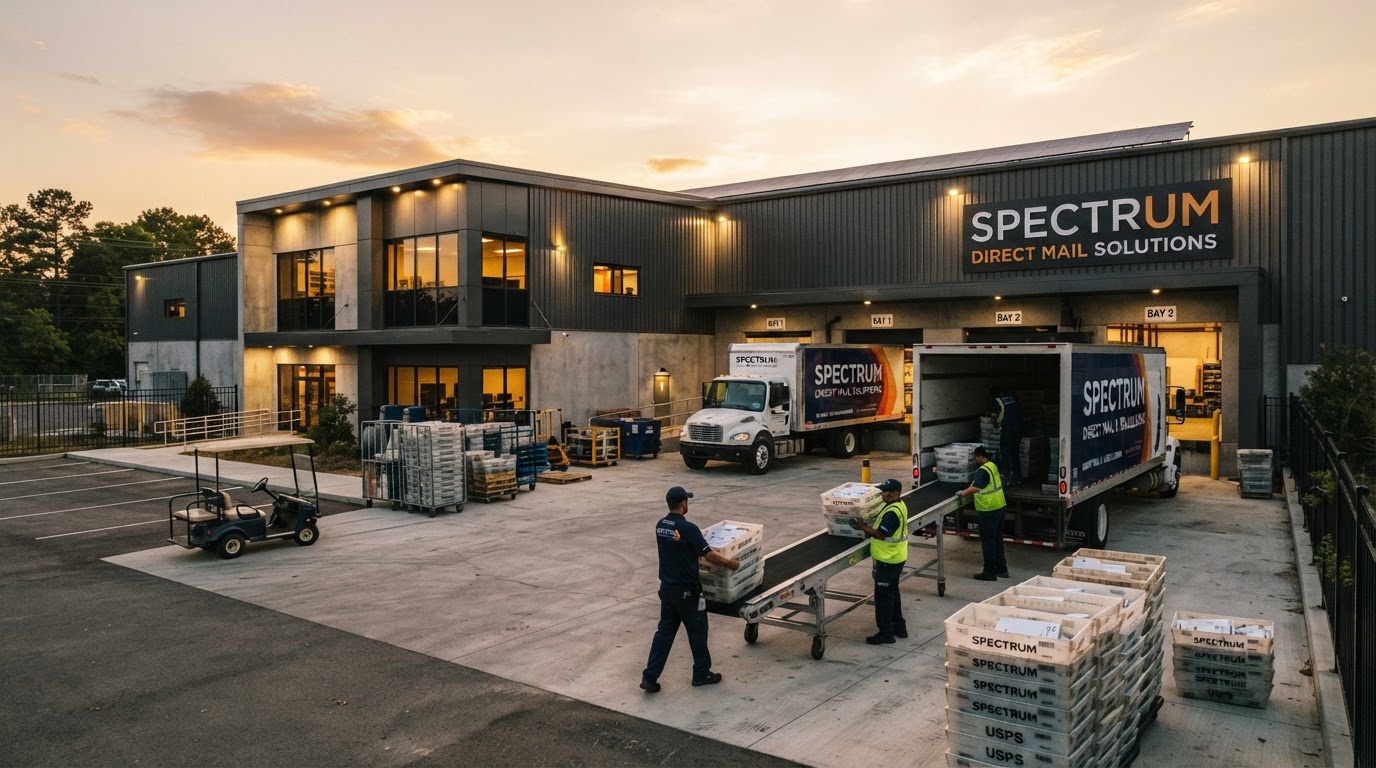
Ask each vendor which production stages they perform in their own facility and which they subcontract. Print, inserting, presort, and drop shipping are the four stages most often brokered. Direct mail companies that run all four under one roof can compress timelines and hold quality at each handoff; those that outsource add lead time and a second margin at every stage. Outsourcing is not disqualifying, but it should be visible and priced honestly.
Equipment and Capacity
Tour the floor if you can, or ask for current equipment lists and typical utilization. Press type and sheet size determine economical run lengths; inserter speed and camera-matching determine inserting accuracy at volume; presort software and commingling volume determine entry discounts. Direct mail companies whose equipment matches your campaign profile will quote lower and deliver more reliably than a bigger name running a mismatched line.
Data Hygiene and Compliance
Confirm how the vendor handles address hygiene (CASS), move update (NCOA), deduplication, and suppression-file processing, and whether they retain or delete list files on a defined schedule. For regulated mail — healthcare, financial, political, or nonprofit — ask about applicable handling, permits, and disclosure. Direct mail companies that cannot describe their data process in detail are a compliance risk the moment your list contains anything sensitive.
Postage Optimization
Postage often exceeds production cost, so it is where vendors differentiate most. Ask about presort levels, commingling participation, and destination entry drops to SCF or NDC, and whether quoted postage is estimated or committed. Direct mail companies that skip entry optimization look cheaper on the production line and cost more in postage; a vendor that presorts and drop-ships can return savings that more than offset a higher per-piece production rate.
Proofing, Turnaround, and Accountability
Ask how proofs are delivered, how many rounds are included, and what happens when a job slips. A published turnaround calendar, a named production contact, and a clear change-order process are signs of a mature operation. Direct mail companies that dodge these questions usually mean the schedule is held in someone's head, and that is where the next rush fee lives. Pick a vendor whose process you can audit, not one whose promises you have to take on faith.
Looking for Targeted Mailing Lists & Data Services Providers?
Browse specialists providing targeted mailing lists & data services across North America.