
Direct Mail Fulfillment: End-to-End Campaign Production Explained
Trace a direct mail campaign from data and creative through print, inserting, presort, and postal induction.
A direct mail campaign looks like a single product to a recipient, but behind the scenes it is a sequence of tightly scheduled production stages. Understanding direct mail fulfillment — the full chain from approved data and creative to in-home delivery — helps marketers set realistic timelines, avoid costly rush fees, and catch problems before mail enters the postal system. This article traces each stage so you can plan campaigns that ship on time.
Stage One: Data and List Preparation
Fulfillment begins with the data file. The mailing list is processed for address accuracy through CASS-certified coding and NCOA move-update hygiene, deduplicated against itself and any suppression files, and segmented by geography, audience, or test cell. Errors caught here are cheap to fix; errors that reach the inserter are expensive. A direct mail fulfillment provider worth working with treats list hygiene as the first quality gate, not an afterthought.
Stage Two: Creative, Proofing, and Imposition
Once data is clean, creative files move to proofing. Variable data is mapped to fields, proofs are reviewed for accuracy and color, and layouts are imposed for efficient press or digital runs. Proofing rounds protect against the two most common failures: a wrong variable mapping that personalizes the wrong field, and a layout that prints fine in isolation but breaks across a press sheet. Locking the proof is the formal start of direct mail fulfillment production; changes after lock almost always cost money and time.
Stage Three: Print Production
Print is where quantity, format, and paper drive cost. Offset is economical at volume for static runs; digital enables shorter runs and full variable personalization without plate costs. Print quality — registration, ink density, folding accuracy — determines whether the piece survives inserting without jams. In a well-run direct mail fulfillment operation, the press and the inserter are scheduled against each other so finished sheets arrive at inserting just in time, not weeks early and not late.
Stage Four: Lettershop Inserting
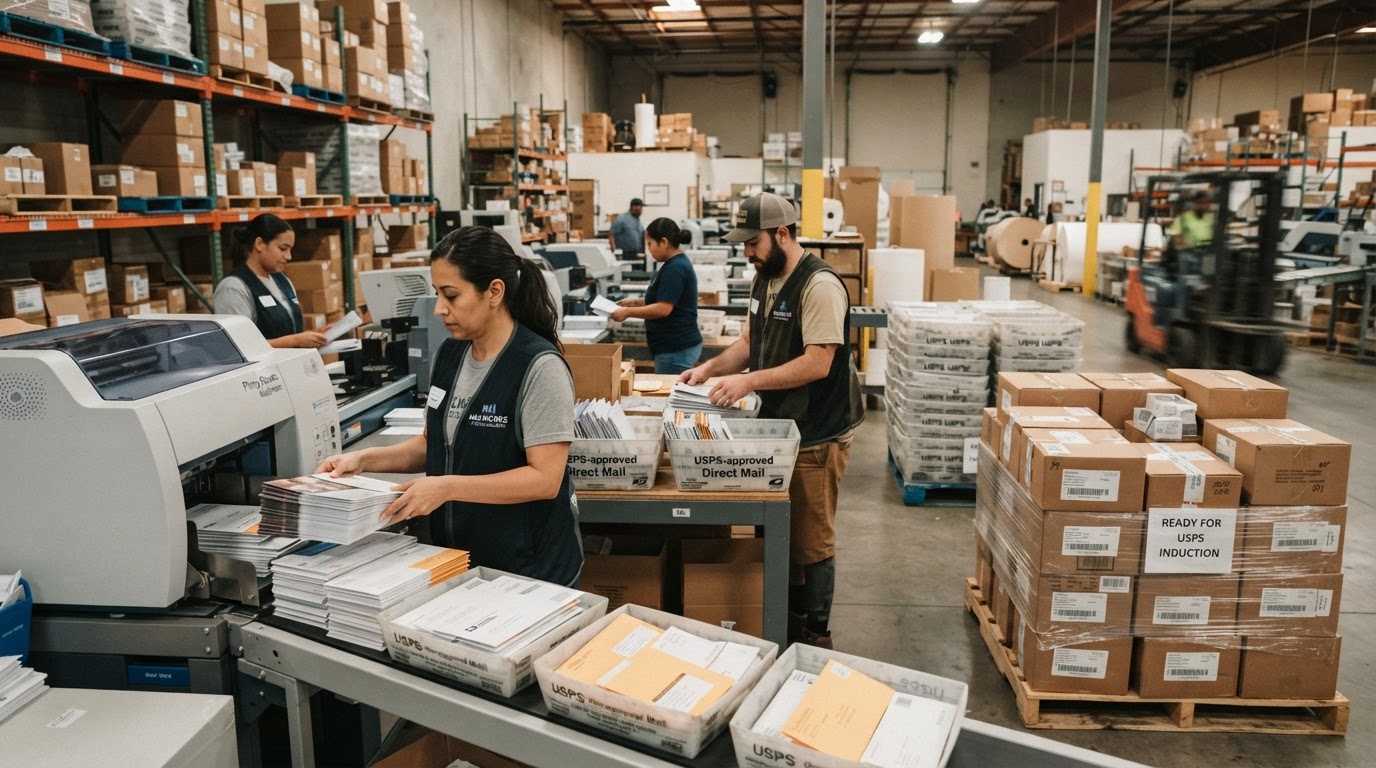
The lettershop is where a flat sheet becomes a mail piece. High-speed inserting machines fold, stuff, seal, tab, and meter or stamp envelopes; for self-mailers, the same line tabs and addresses the piece. Camera-matching verifies that the right variable piece goes into the right envelope. This stage is the operational heart of direct mail fulfillment, and the skill of the crew running it determines whether a 100,000-piece drop runs clean or generates rejects that have to be reprinted and reinserted.
Stage Five: Presort, Commingling, and Induction
Sorted mail earns postage discounts. Mail is presorted to USPS standards, commingled with other mail for deeper entry discounts, and palletized for drop shipping to SCF or NDC entry points. The drop ship itself — loading pallets and delivering them to the postal facility within the appointment window — is the last act of fulfillment and the first act of delivery. A breakdown at induction can stall an entire campaign, so reliable direct mail fulfillment partners treat the appointment as a hard deadline and build the whole schedule backward from it.
Looking for Kitting & Dimensional Mail Fulfillment Providers?
Browse specialists providing kitting & dimensional mail fulfillment across North America.