
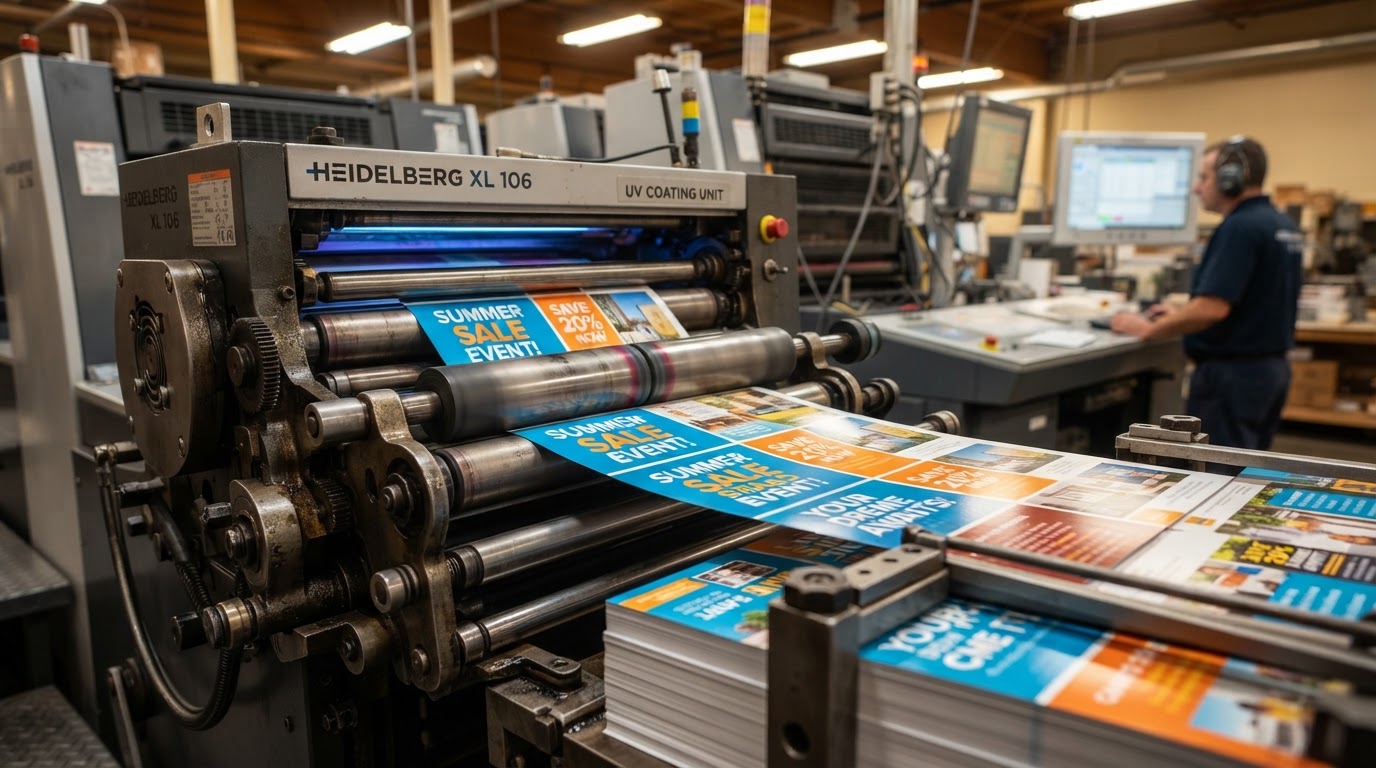
Essential Direct Mail Printing Specs: Postcards, Mailers & Paper Weights
Learn how to choose paper stock, coating, UV gloss, and die-cut options to maximize direct mail response rates while staying USPS compliant.
Direct mail printing requires precise technical specifications to balance tactile quality, visual impact, and USPS postage efficiency. Choosing the right paper stock, coating, and trim size directly impacts both recipient response rates and production costs. A piece that feels cheap or arrives damaged undermines even the strongest offer, while a well-engineered mailer conveys credibility before the recipient reads a single word. This guide walks through the specifications that matter most, how they interact with postal regulations, and how to optimize every choice for response and cost.
Paper Weight & Stock Selection
Standard direct mail postcards rely on 100lb, 14pt, or 16pt premium cover stock. 16pt heavy cover stock provides a sturdy, substantial feel in the recipient's hand, conveying credibility and brand authority. For multi-page mailers, newsletters, or self-mailers, 80lb or 100lb text stock offers flexible folding without paper cracking. The weight you select also affects postage: USPS bases part of its pricing on thickness and rigidity, and undersized or flimsy pieces can trigger non-machinable surcharges.
When choosing stock, consider the audience and the offer. A high-ticket B2B invitation or a luxury real estate piece benefits from 16pt or even 22pt stock with a soft-touch finish, because the tactile impression primes the recipient to perceive value. A high-volume EDDM retail postcard, by contrast, is often optimized for the lowest qualifying weight that still passes USPS automation guidelines, keeping postage down while still meeting dimensional requirements.
Finish & Coating Options
- **UV Gloss Coating:** High-shine protective finish that enhances color vibrancy and protects against scuffing during postal high-speed sorting machines. UV coating can be applied flood (full coverage) or spot (selective highlights) to draw attention to specific design elements.
- **Matte / Satin Finish:** Elegant glare-free appearance ideal for luxury brands, professional service firms, and handwritten-style mailers where glare would interfere with readability.
- **Soft-Touch Velvet:** Premium tactile velvet texture that creates an instant tactile contrast in the mailbox and signals a high-end product or offer.
- **Aqueous Coating:** A water-based fast-drying coating applied inline on press, offering economical protection with lower environmental impact than UV.
- **Uncoated:** Best when a writable surface is needed (for response cards, donation forms, or handwritten notes) or when a natural, artisanal feel suits the brand.
Coating choice should also consider the finishing steps that follow printing. Pieces that are glued, tabbed, or inserted must use a coating compatible with adhesives — a UV-glossy panel where a wafer seal must stick can cause tabs to fall off in transit, leading to USPS rejects.
Variable Data Printing (VDP)
Modern digital printing presses allow full personalization on every single piece. From personalized greetings and custom coupon offers to localized map graphics, variable data printing increases response rates by up to 135% compared to static mailings. VDP works by merging a design template with a data file at print time, swapping names, images, offers, and even entire layouts per recipient.
Common VDP applications include personalized salutations, nearest-store mapping, renewal offers based on past purchase history, and dynamic imagery that changes with the recipient's demographic profile. The key to effective VDP is data quality: personalization built on outdated or incorrect data does more harm than good. Run your list through CASS and NCOA hygiene before any VDP job to prevent the embarrassment of a mis-addressed personalized piece.
Die-Cuts, Folds & Finishing
Beyond the stock and coating, the physical shape of a mailer affects response. Standard trim sizes keep costs low, but die-cut outlines, perforated tear-off coupons, and creative folds (gate-fold, z-fold, accordion) can elevate a piece above the ordinary. Keep in mind that unusual shapes may push a piece into a non-machinable or letter vs. flat classification, which can change postage significantly. Always confirm the final folded dimensions and thickness against the current USPS pricing charts before committing to a design.
Working with Your Print Provider
Bring production specs into the conversation early. Share the intended trim size, paper weight, coating, fold, tabbing, and mailing requirements with your print and lettershop partner at the design stage — not after the file is on press. A collaborative provider will flag postal compliance issues, recommend stock substitutions that save money, and suggest finishing tweaks that improve in-home deliverability. Request a hard-copy proof on the actual stock whenever possible, because color, weight, and coating all look different on screen than in the hand.
Balancing Quality and Cost
The strongest direct mail campaigns optimize for cost-per-response, not cost-per-piece. Spending a few cents more per piece on heavier stock and better coating can lift response enough to lower the effective cost per acquisition. Conversely, over-engineering a high-volume EDDM drop with premium finishes can erase the postage savings that make EDDM attractive. Match the production values to the offer value, the audience, and the expected lifetime value of a converted recipient, and you will consistently print mailers that pay for themselves.
Looking for Direct Mail Printing & Production Providers?
Browse verified specialists providing direct mail printing & production across North America.