
Winning Voters with Political Direct Mail: Rapid Turnaround & Micro-Targeting
How political campaigns, PACs, and unions leverage red-tag election mail, union-bug printing, and micro-targeted voter lists to drive turnout.
Direct mail remains one of the most trusted and influential communication channels in political campaigns, cutting through digital clutter directly to voters' kitchen tables. While email and social media saturate inboxes and feeds, a physical piece of mail commands a different kind of attention — it must be physically handled, it lives on a counter or refrigerator, and it reaches voters who rarely engage online. For turnout, persuasion, and GOTV (get-out-the-vote) efforts, direct mail is still a foundational medium that complements a campaign's digital program.
Rapid 24-Hour Production Turnarounds
Elections demand immediate responsiveness. Leading political mail providers maintain dedicated 24 to 48-hour print and mail turnarounds to respond quickly to opponent claims, endorsement drops, or urgent voting reminders. The ability to conceive a piece in the morning, proof it by lunch, and have it in the mailstream by evening is a strategic advantage in the compressed weeks before Election Day. When selecting a political mail partner, confirm their real-world turnaround — not the one in the brochure — and ask for examples of recent rapid-response jobs.
Rapid turnaround is not just about printing speed. It requires pre-staged materials, standby press time, and a lettershop that can move from file receipt to induction without delays. Campaigns that wait until the last week to engage a mailer often find that the cheapest quotes carry the longest queues. Lock in capacity early, even if the creative is still in flux.
Official USPS Election Mail Red Tagging
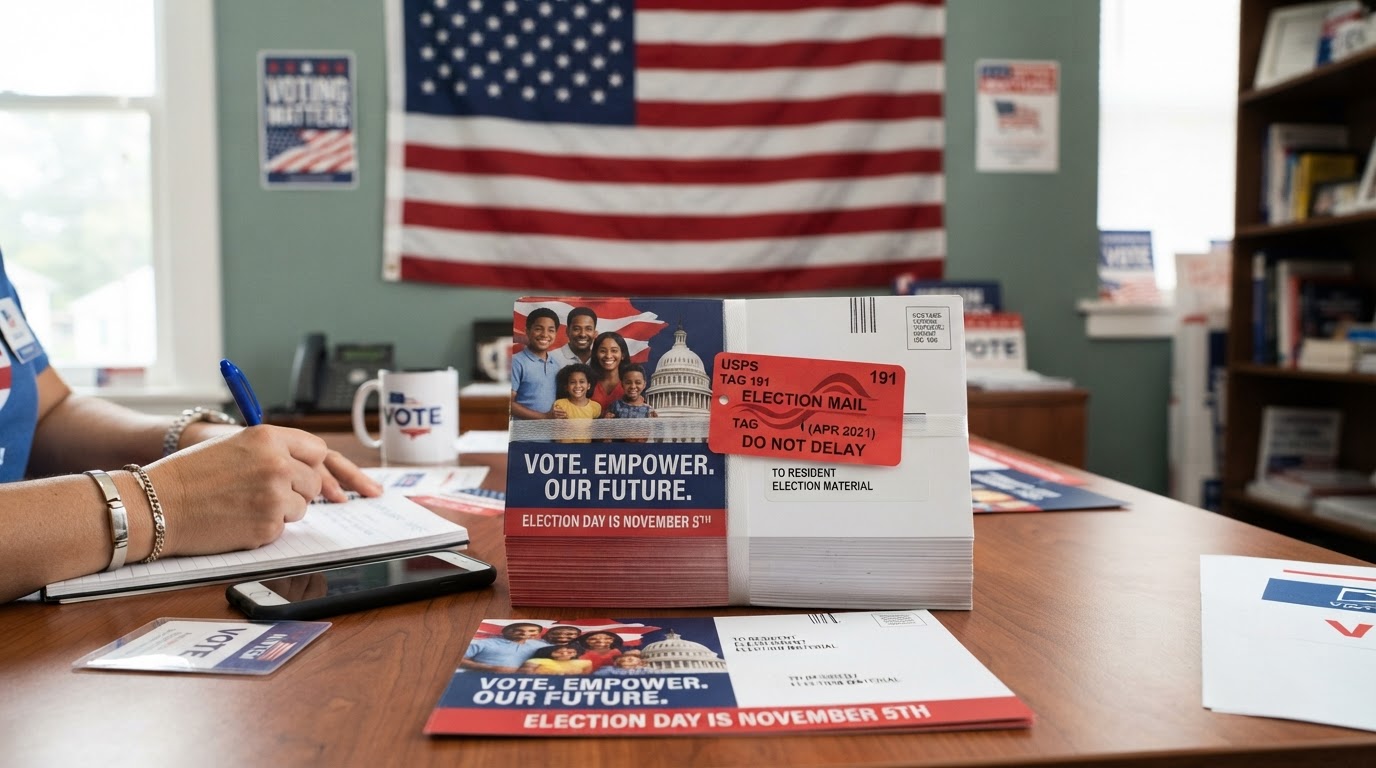
Official political campaign mailings utilize USPS Red Tag 191 labels. These red tags alert postal workers that election mail must be given priority handling through sorting facilities to ensure delivery ahead of Election Day. Red-tagging does not guarantee a specific delivery date, but it signals priority within the postal system and is recognized at every level of the USPS network. Any political mailer worth hiring will apply red tags automatically for election-period drops.
Micro-Targeting and Voter File Selection
Modern voter files, enriched with consumer overlays and modeled partisanship, allow campaigns to segment audiences with extraordinary precision. Common political selects include:
- Likely partisan lean (modeled or registered party where available).
- Vote history — frequency of past turnout, presence in the last comparable election.
- Age, household composition, and homeownership for issue-based targeting.
- Geographic granularity down to precinct and polling location.
- Issue overlay — environmental, union membership, second-amendment, senior concerns, and more.
The most effective political mail pairs targeting with message: different segments receive different creative, each speaking to the issue that motivates that group. Blanketing every voter with the same piece underperforms a segmented program where each audience hears its most resonant message.
Union-Bug and Endorsement Printing
A union bug — the small mark indicating the piece was printed by union labor — is a requirement for many labor-backed campaigns and a signal of values for others. If your campaign needs a union bug, confirm your printer holds the appropriate union affiliation and can apply the correct mark. Endorsement logos work the same way: they must be applied at the design stage with the endorsing organization's permission, and they should be reproduced at a size and resolution that the endorser approves.
GOTV Timing and In-Home Windows
The most valuable political mail arrives in the final days before an election, when it can drive turnout and remind voters of polling logistics. Plan your mail calendar around in-home delivery windows — not the date you drop it in the mailstream — and build in buffer for postal variability. A piece that arrives the day after Election Day is wasted spend. Work with your mailer to time drops against the postal calendar for your target geographies, especially for mail that must cross SCF or DDU boundaries.
Compliance and Disclosure Requirements
Political mail carries disclosure obligations: paid-by disclaimers, FEC or state-level registration numbers, and in some cases additional printer and author identification. These requirements vary by jurisdiction and by whether the spender is a campaign, a PAC, or an independent expenditure. Confirm the required disclosures before final files go to press, because a missing disclaimer is not a minor error — it can trigger complaints and penalties.
Coordinating Mail with Digital
The strongest programs use direct mail and digital in coordinated sequence: mail primes awareness and credibility, digital retargets mail recipients who show interest, and mail arrives again to drive the final GOTV push. Use matched audiences or response tracking where feasible, and ensure your mail and digital teams are working from the same voter universe and message calendar. A coordinated program outperforms disconnected channels.
Measuring Political Mail Effectiveness
Attribution in political mail is harder than in commercial mail — voters do not always "convert" in a trackable way — but it is not impossible. Compare turnout in mail-targeted precincts against comparable untargeted precincts, run post-election surveys, and layer mail drops against polling movement. Over a cycle, these signals tell you which segments and messages actually moved voters, so the next campaign is sharper than the last.
Looking for Political Campaign & Nonprofit Mailing Providers?
Browse verified specialists providing political campaign & nonprofit mailing across North America.