
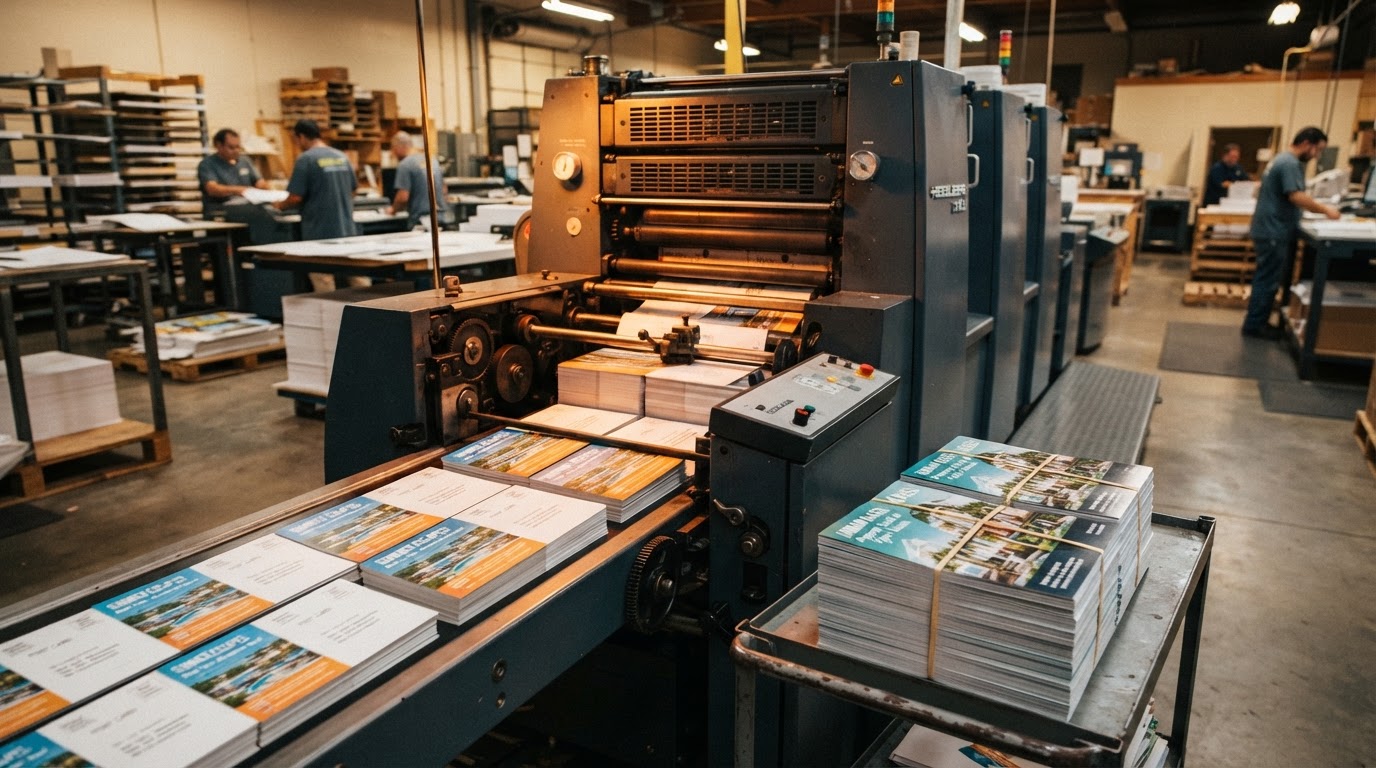
Direct Mail Printing and Mailing: Specs, Formats, and Production Tips
Practical guidance on paper, formats, finishes, and USPS machinability for direct mail printing and mailing.
Direct mail printing and mailing is where creative intent meets postal reality. A piece that looks beautiful in a proof can fail at the inserter, lose its automation discount, or arrive damaged if the specs do not match what the equipment and the postal system can actually handle. Getting the specifications right up front protects both deliverability and cost, and it is the single most overlooked source of surprise invoices.
Paper Weight, Finish, and Machinability
Paper weight and finish affect both appearance and machinability. A text weight that is too light can jam in inserting or fail to qualify for automation pricing; a cover weight that is too heavy can exceed thickness limits and trigger non-machinable surcharges. Coated stocks can resist wafer tabs and cause seal failures. When you scope direct mail printing and mailing, specify the exact weight and finish and confirm it against USPS size and weight standards before you commit to creative.
Formats: Postcards, Self-Mailers, Letter Packages, and Catalogs
Each format has different cost and response characteristics. Postcards are cheap, fast, and high-visibility but limited in content. Self-mailers carry more content without an envelope but require tabs and strict folding. Letter packages are the workhorse of acquisition and renewal but add inserting complexity and cost. Catalogs carry the most content and highest postage but demand the longest lead time. Direct mail printing and mailing economics improve when the format is chosen for the message rather than the other way around.
Personalization and Variable Data
Variable data printing lets every piece carry unique names, offers, images, or even layouts — but it adds data and production complexity. The data file has to be clean, the mapping has to be proofed, and the print method has to support the version count. Digital print handles full variability at lower volume; offset is cheaper at high static volume but loses its advantage once the number of versions multiplies. Spec personalization precisely so the provider can quote the right method.
Finishing: Folding, Die-Cutting, Coatings, and Tabs
Finishing operations — folding, die-cutting, spot coatings, perforations, and tab placement — are where a clean design becomes a mailable piece. A fold that does not clear the inserter, a coating that rejects the tab, or a perforation that tears in sorting all create rejects and cost. The most experienced direct mail printing and mailing partners review finishing against inserting early, so a design change in prepress is cheaper than a reprint on the floor.
USPS Alignment and Cost Control
Finally, align every spec to the postal class and pricing you intend to qualify for. Size, thickness, weight, tabbing, and addressing standards all affect whether a piece earns automation or letter-shape pricing or is downgraded. Quoting direct mail printing and mailing against the correct postal class — and rechecking when the design changes — is what keeps the postage on the invoice equal to the postage on the plan.
Looking for Direct Mail Printing & Production Providers?
Browse specialists providing direct mail printing & production across North America.