
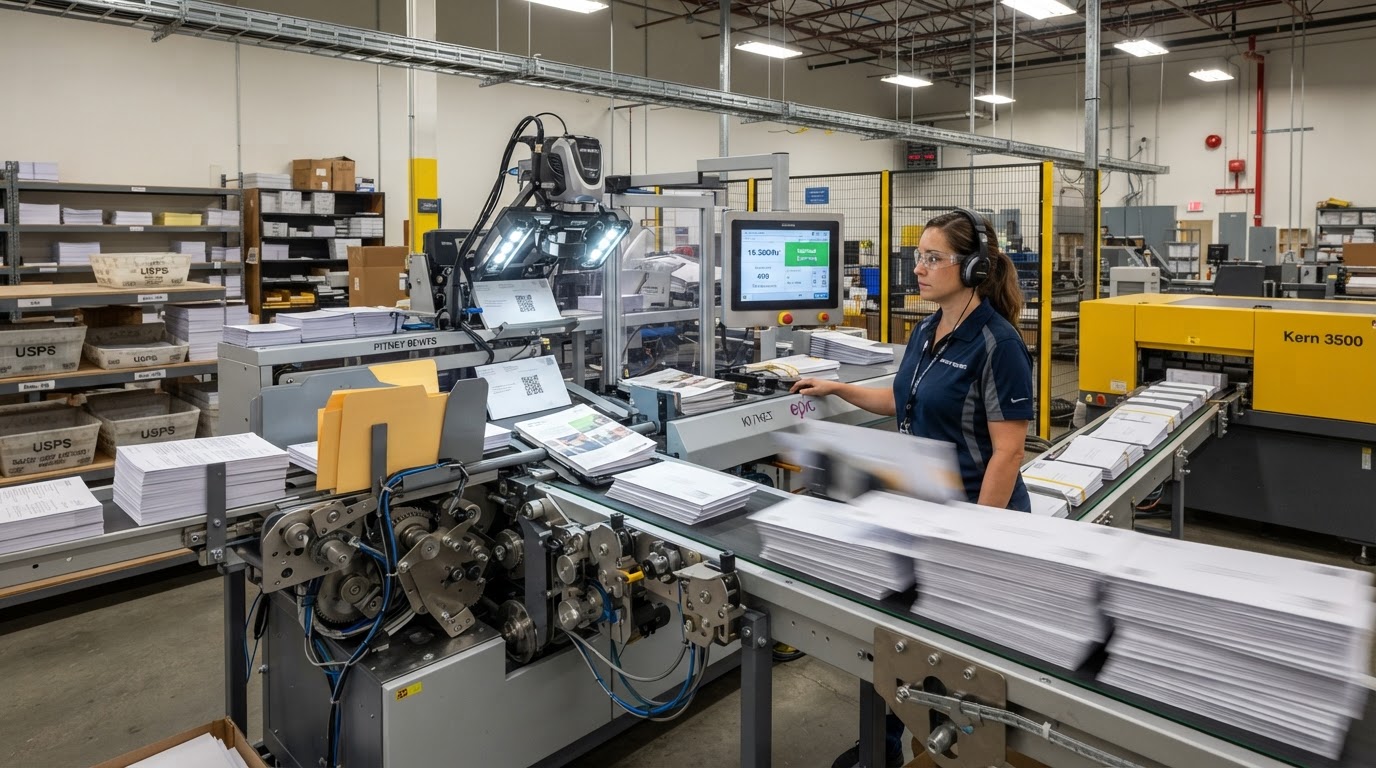
Inside the Modern Lettershop: Camera Matching, Inserting & Tabbing
Explore the automated lettershop technology that inserts, seals, tabs, and meters millions of direct mail envelopes with pinpoint accuracy.
Lettershop fulfillment transforms raw printed sheets, envelopes, and inserts into mailable postal packages. Advanced high-speed inserting equipment ensures precision and security. A modern lettershop is less a print shop and more an automated manufacturing line: incoming printed materials are matched, folded, inserted, sealed, tabbed, metered, sorted, and trayed at industrial speeds, with camera-based inspection catching errors before a single piece enters the mailstream.
The Lettershop Workflow
A typical lettershop job moves through several stages, each tightly controlled:
- **Receiving and inventory:** Printed components — letters, inserts, BREs (business reply envelopes), outer envelopes — are received, counted, and staged. Reconciliation against the job ticket catches shortages before production begins.
- **Folding and collating:** Sheets are folded (half-fold, z-fold, tri-fold) and collated into the correct page order for inserting.
- **Inserting:** High-speed inserting machines open envelopes, load the collated package, and seal them — running from thousands to tens of thousands of pieces per hour depending on the equipment.
- **Tabbing and wafer sealing:** Self-mailers and folded pieces are tabbed shut to meet USPS non-machinable and automation requirements.
- **Metering and postage application:** Postage is applied via an indicia, meter, or preprinted permit, with the correct rate per piece.
- **Sorting and tray tagging:** Mail is sorted to the required USPS destination level (5-digit, 3-digit, origin/destination SCF) and trayed with the correct facing tags.
- **Induction:** Completed trays are delivered to the post office or a Destination Delivery Unit, with USPS acceptance paperwork.
Understanding the full workflow helps you anticipate lead times, design mail pieces that run efficiently on equipment, and avoid finishing choices that slow or stall production.
Intelligent Camera Matching
When sending personalized letter packages containing sensitive account details or personalized offers, camera-matching inserters scan 2D barcodes on both the letter and insert. If a mismatch occurs, the machine instantly halts, preventing privacy breaches. Camera matching is the lettershop's most important safeguard for regulated industries — financial services, healthcare, insurance — where mailing the wrong insert to the wrong recipient is not just an error but a compliance violation.
Modern camera systems can match multiple inserts per envelope, verify sequence, and confirm that every piece in a multi-component kit belongs together. For high-volume statement mailings, camera matching dramatically reduces the rework and customer-service fallout that come from mismatched packages, and it produces an auditable record of what was mailed to whom.
Wafer Seals & Tabbing Requirements
Self-mailers and folded brochures require wafer tabbing to prevent open edges from jamming USPS high-speed sorting machines. USPS regulations dictate tab quantity, size (usually 1" or 1.5" translucent seals), and placement depending on paper weight and fold direction. Two-tab configurations are common for bi-folded pieces, while open-edge tri-folds may require a three-tab pattern.
Tabbing also affects design: the creative team must account for where tabs will land so they do not cover critical copy or imagery. Some mailers use spot-tabbing on a contrasting clear tab for a clean look, while others opt for resealable tabs that let the recipient re-close the piece after opening. Confirm the tab plan with the lettershop during the design phase, because changing tabbing after the piece is printed often means retooling on the inserting floor.
Inline vs. Offline Production
Inline systems print, fold, insert, and meter in a single continuous pass, which is fast and efficient for large runs. Offline systems separate printing from inserting, which offers more flexibility for complex kits or smaller quantities. The right choice depends on run length, personalization complexity, and turnaround urgency. A high-volume credit-card statement run is an ideal inline job; a low-volume dimensional kit with hand assembly belongs offline.
Quality Control and Sampling
Reputable lettershops pull statistical samples throughout the run to verify match rates, insert completeness, weight, and seal integrity. Ask for the QC plan and the acceptance criteria before production starts. A well-run lettershop can document, for every job, the match rate achieved and any rejects removed — which matters when auditors or regulators come asking.
Turnaround and SLA Considerations
Turnaround is measured from the moment clean files and materials arrive, not from when the order is placed. Build time into your schedule for file QA, material staging, machine setup, run time, USPS acceptance, and induction. For time-sensitive drops — statements, renewal notices, political mail — negotiate an SLA up front and confirm the lettershop's capacity to meet it. The cheapest lettershop is rarely the best one when a missed in-home window costs you a customer.
Choosing a Lettershop Partner
Look for a partner whose equipment matches your mail mix (envelope volumes vs. self-mailer volumes), whose QC culture is visible, and whose capacity can absorb your peaks without pushing your schedule. A good lettershop will review your design for manufacturability before quoting, flag finishing and postal issues, and suggest changes that lower your cost per piece. The relationship pays compounding returns: the better the partner understands your mail, the more efficiently they can run it.
Looking for Lettershop & Mail Insertion Services Providers?
Browse verified specialists providing lettershop & mail insertion services across North America.