
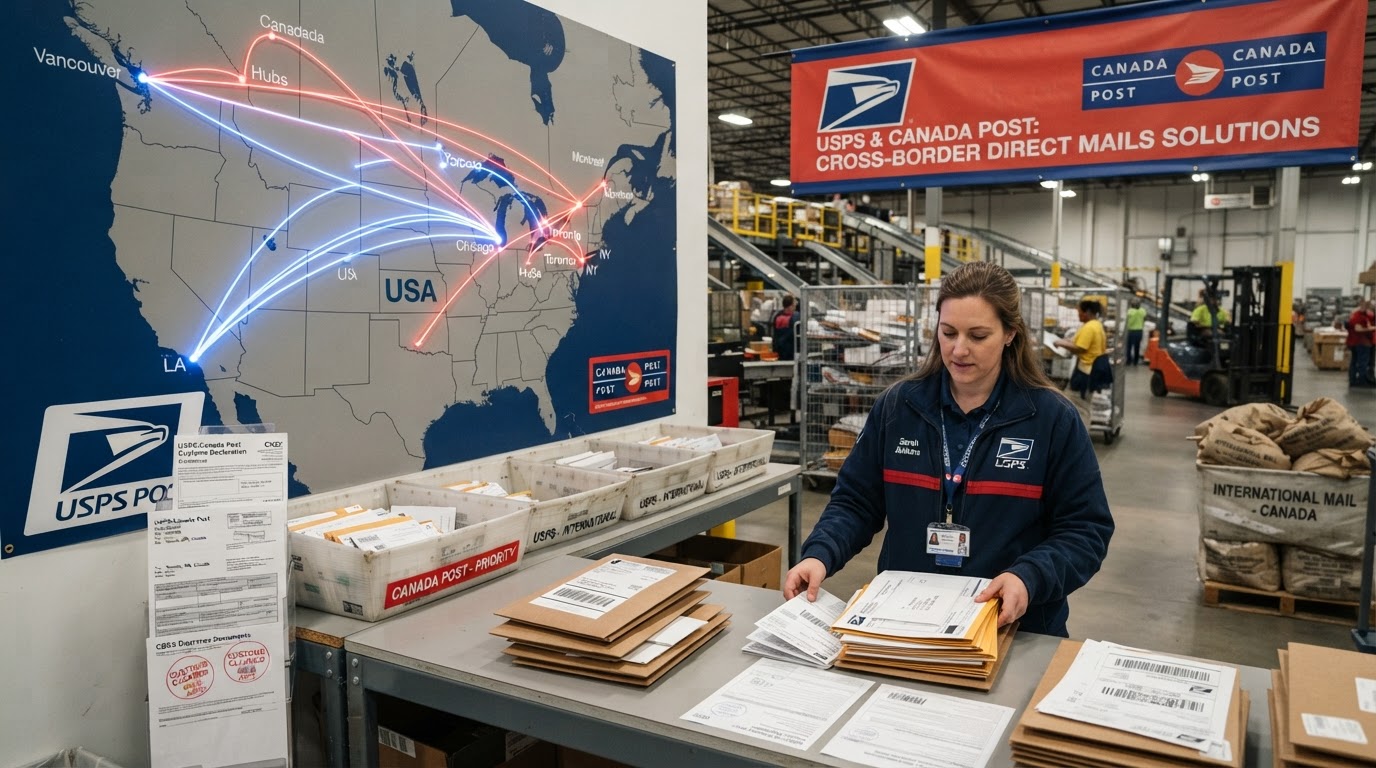
Cross-Border Direct Mail: Navigating Canada Post & USPS Regulations
A guide for international brands executing dual direct mail campaigns across both the US and Canadian markets.
Expanding direct mail campaigns between the United States and Canada requires understanding key differences in postal guidelines. What works south of the border does not always translate north, and a cross-border program that ignores those differences will deliver late, cost more than expected, or run afoul of language and customs rules. For brands serving both markets, a coordinated cross-border mail strategy is the difference between a seamless North American program and a series of expensive lessons.
USPS vs Canada Post Key Differences
- **USPS EDDM vs Canada Post Neighborhood Mail:** Both offer unaddressed route saturation, but size and bundling rules differ. Canada Post Neighborhood Mail has its own dimension, weight, and bundle specifications that are not interchangeable with USPS EDDM.
- **Postal codes and addressing:** Canadian addresses use a six-character alphanumeric postal code and follow different address formatting conventions than US ZIP codes.
- **Postage and pricing structure:** Canada Post pricing, incentive tiers, and volume discounts differ from USPS; a rate that works for one market will not map to the other.
- **Induction and delivery standards:** Delivery timelines and induction points differ, and cross-border mail must clear customs before induction into the destination country's network.
Designing one creative for both markets is rarely efficient; plan the creative and the mail file as two coordinated but distinct productions.
Language Requirements
Canadian mailings entering Quebec must comply with provincial French language rules, and many brands choose to mail bilingual pieces across Canada to serve both language communities. The rules extend beyond the mail piece itself to response channels — a French-speaking recipient who calls a number should be able to be served in French. Build language and regional compliance into the planning stage, not after the piece is designed, because retrofitting bilingual or Quebec-specific versions is expensive and error-prone.
Customs Clearance for Cross-Border Mail
Consolidated cross-border freight requires customs clearance documentation before postal induction. Mail moving from the US to Canada (or vice versa) is freighted to the destination country and inducted locally, which means it must clear customs as a shipment. The documentation includes commercial invoices, descriptions, value, and origin. A mailer experienced in cross-border logistics handles this routinely; a mailer that does not will create delays, returned freight, or customs holds that blow the in-home window.
Address and Data Hygiene Across Borders
US and Canadian address data follow different standards. US lists run through CASS/NCOA; Canadian lists run through Canada Post's address-verification tools and the National Change of Address equivalent. A US-hygiene pass on a Canadian list (or vice versa) will not catch the same errors, because the formats and the postal systems are different. Run each market's list through the hygiene appropriate to that market, and do not assume a single global hygiene tool covers both.
In-Home Timing Across Borders
Cross-border mail typically takes longer than domestic mail in either country, because it includes freight, customs, and induction into the destination network. For time-sensitive campaigns — a coordinated US-Canada product launch, a cross-border promotion — build the extra lead time into the schedule and coordinate the two mailings so they arrive in their intended windows. Confirm the delivery standards with your cross-border mailer for each destination, because the in-home curve is not symmetric.
Coordinating Creative and Branding
A North American campaign should feel coherent across both markets, but it should respect local requirements. Common practice is a shared creative concept with market-specific localization — language, address formats, offer currency, response channels — produced as two coordinated versions. The brand stays consistent; the execution respects the postal and linguistic realities of each country. A cross-border mailer that produces both versions in one shop avoids the coordination cost of two separate vendors.
Cost and Volume Considerations
Cross-border mail benefits from volume consolidation, but the savings differ by direction. US-to-Canada and Canada-to-US each have their own freight, customs, and induction economics, and the optimal drop strategy depends on where the volume and the destination addresses concentrate. Work with a mailer that can model both directions and recommend where to consolidate, where to drop ship, and where to mail locally. The savings from getting the cross-border logistics right are often larger than the per-piece creative decisions.
Regulatory and Privacy Compliance
Cross-border data movement raises privacy considerations. Moving a list across the US-Canada border may implicate data-protection rules in one or both countries, depending on the data involved. Understand what personal data is in your mail file, whether it may cross the border, and what consent or notices are required. A compliant cross-border program is not just about postal logistics — it is about handling the underlying data lawfully.
Building a North American Mail Program
A mature cross-border mail program treats the US and Canada as a coordinated North American market with market-specific execution. It uses the right hygiene, language, customs, and induction for each country; it coordinates timing so cross-border campaigns land in the intended windows; and it measures results by market so the program improves over time. For brands that serve both countries, this is how mail becomes a scalable continental channel rather than two disconnected, inefficient efforts.
Looking for Presort & Postal Rate Optimization Providers?
Browse verified specialists providing presort & postal rate optimization across North America.