
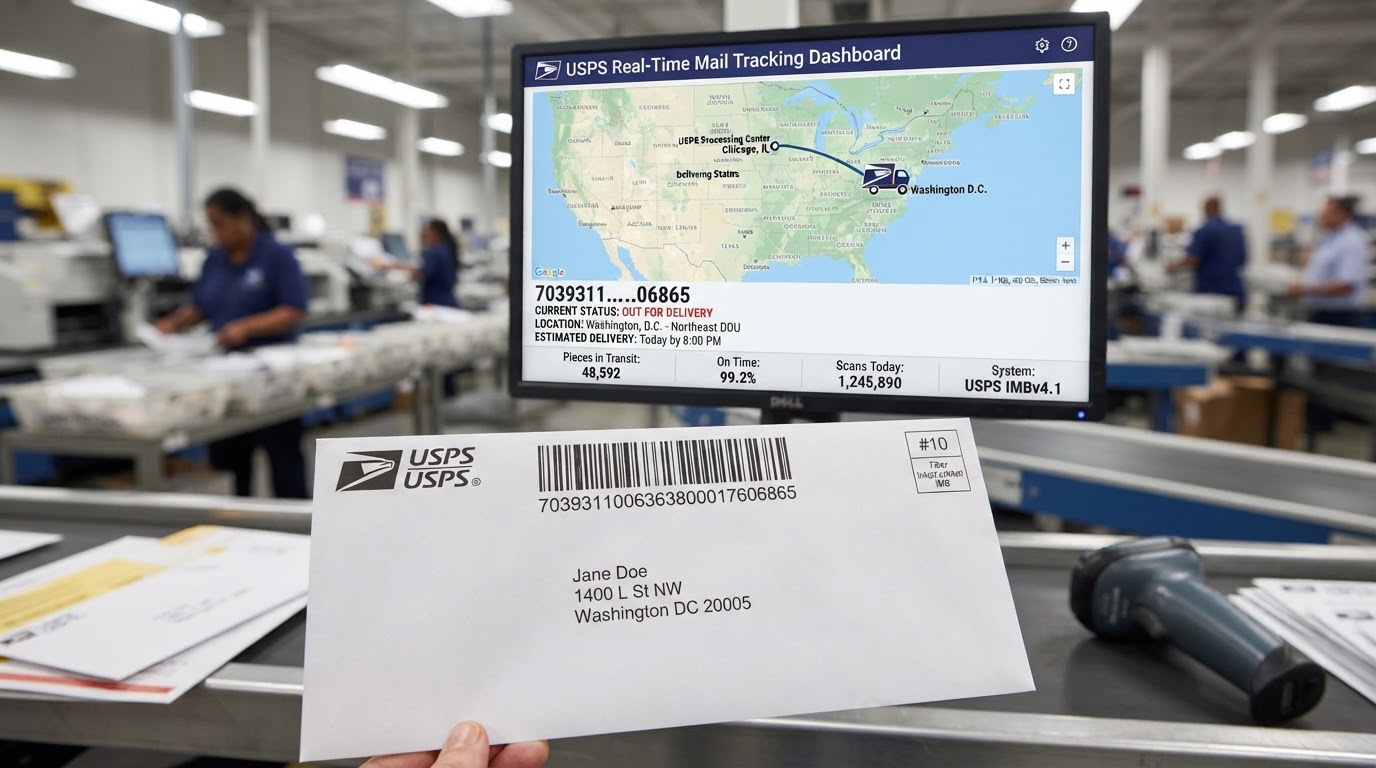
Intelligent Mail Barcode (IMB) Tracking: Real-Time Mail Delivery Visibility
How IMB scanning provides real-time visibility into when direct mail pieces hit customer mailboxes.
The USPS Intelligent Mail Barcode (IMB) is a 65-bar code that tracks mailpieces as they move through automated postal sorting equipment. It is the single most important technology for closing the visibility gap between dropping a piece in the mail and knowing it reached the mailbox. For any campaign where timing, follow-up, or coordinated digital activation matters, IMB tracking turns direct mail from a black box into a measurable, orchestrated channel.
What the IMB Encodes
Each IMB encodes a unique Mailer ID and a Serial Number for every piece, plus the delivery point (routing ZIP) and optional service-level data. Because every piece can carry a unique serial number, the IMB lets you identify each individual mailpiece as it is scanned — not just the drop, but the specific recipient. That per-piece granularity is what enables the operational and marketing use cases that make IMB tracking so valuable.
Operational Advantages of IMB Tracking
- **Sales Team Alerting:** Notify phone sales teams the exact day mail arrives in a targeted city or neighborhood, so follow-up calls land when the recipient has the piece in hand.
- **Synchronized Digital Ads:** Launch retargeting emails and digital banners precisely when the physical postcard lands in the customer's mailbox, multiplying the impact of both channels.
- **Delivery Audit Reporting:** Verify actual postal delivery dates against carrier commitments, so you can hold the USPS and your mailer accountable and plan around real in-home curves.
- **Non-Delivery Detection:** Identify pieces that never scanned through to delivery point — lost, undeliverable, or mis-routed — so you can re-mail or suppress in future drops.
IMB vs Postnet
IMB replaced the older Postnet barcode. Postnet encoded only the delivery point; IMB encodes the delivery point plus the unique piece identifier and service-level data. The upgrade from Postnet to IMB is what made per-piece tracking possible, and any mailer still using Postnet is sending untrackable mail. Confirm that your mailer applies full-service IMB — not just the basic IMB that lacks the unique-piece scans — because full-service IMB is what unlocks the tracking data.
Informed Visibility and the Scan Signal
USPS Informed Visibility is the data product that surfaces IMB scan events back to mailers. As a piece moves through the sorting network — acceptance, processing, delivery — each scan is logged and made available. The delivery-point scan is the signal that the piece reached the destination mailbox, and that signal is what powers the operational and marketing use cases. The data arrives with some delay, so plan your follow-up sequences around the realistic scan lag, not an idealized real-time feed.
Coordinating Mail and Digital
The highest-value IMB use case is synchronizing physical mail with digital follow-up. When the IMB scan shows the piece has been delivered, trigger the digital sequence — a coordinated email, a retargeting ad, a sales call. The recipient experiences a coherent multichannel touch rather than a disconnected set of messages, and response lifts measurably when the channels reinforce each other at the right moment. The technical lift is manageable: route the scan signal to your marketing automation or CRM and trigger the workflow.
Sales Follow-Up and the In-Home Moment
For high-value mail — account-based outreach, premium offers, renewal notices — the moment the piece lands is the moment to follow up. IMB delivery scans let you time that follow-up precisely, so the salesperson calls when the prospect has the piece on their desk rather than days later when it has been buried. The lift from timed follow-up is often the difference between a mail program that produces meetings and one that produces silence.
Audit, Compliance, and Dispute Resolution
For regulated or time-sensitive mail — statements, notices, legal mail — the IMB scan record is an auditable proof of mailing and delivery. When a recipient claims they never received a piece, the scan history shows whether it was processed and delivered. For dispute resolution and compliance, that record is invaluable, and it is one of the reasons regulated industries rely on IMB-tracked mail.
Data Integration
Integrating IMB tracking requires connecting the scan data to your systems. The most common pattern: the mailer or a tracking platform provides scan events via API or file feed, and your CRM or marketing automation consumes them and triggers workflows. Confirm the integration method with your mailer before the drop, because retrofitting tracking to an already-mailed drop is not possible — the IMB must be applied and registered at production time.
Building a Tracked Mail Program
A mature IMB-tracked mail program does more than count scans. It uses delivery events to coordinate digital, alert sales, audit delivery, and measure the true in-home performance of every drop. The investment in tracking pays back through better-timed follow-up, higher conversion, and the ability to prove delivery when it matters. For any mailer running campaigns where timing and accountability matter, IMB tracking is not optional — it is the foundation of a modern, measurable direct mail program.
Looking for Presort & Postal Rate Optimization Providers?
Browse verified specialists providing presort & postal rate optimization across North America.